Natural Method Effectiveness

The ‘why’ of Fertility Awareness Methods
- Promotes shared responsibility
- Draws a couple closer
- Heightens our sense of awe in lovemaking
- Allows for God’s involvement in our discernment
The most effective and healthiest way to cooperate with each other and with God is to use a Fertility Awareness Method (FAM). There is no need to overwhelm a woman’s natural body rhythms with chemicals or permanently sterilise either a husband or wife to avoid pregnancy. Modern science has developed consistently reliable and practical methods of tracking and determining a woman’s fertility.
These methods also respect the intrinsic sacredness of the couple’s sexual communion, which is one of the reasons why FAMs are the only methods of birth regulation approved by the Church.
As the table below illustrates, FAMs hold their own in terms of reliability and far out class contraceptives when it comes to side effects and health risks.
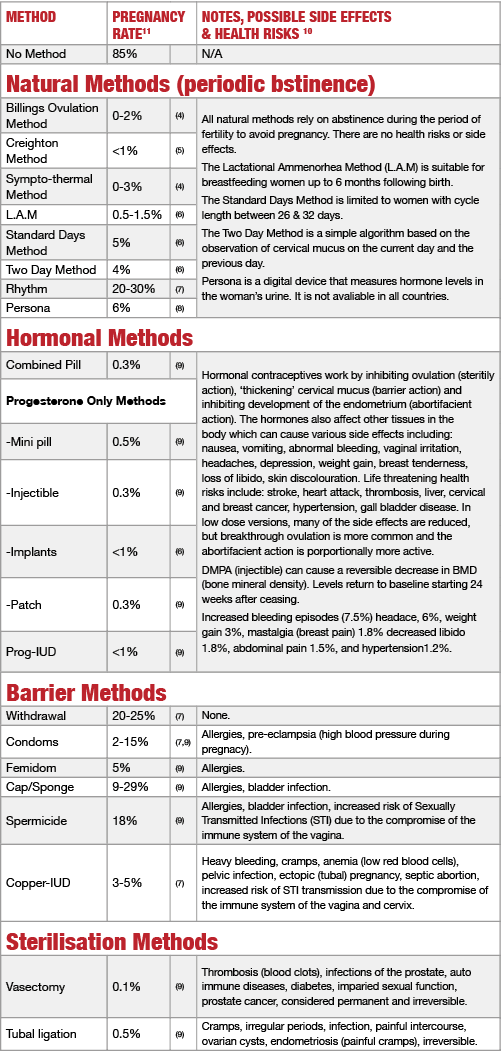 The Pregnancy Rate is taken from various sources and is the Method Effectiveness (unplanned pregnancy in first year of perfect use). This measure is one standard means used to describe the percentage of women per year who have an accidental pregnancy while properly applying the method. This measure does not include pregnancies that result from incorrect use. The ‘User Effectiveness’ is a more realistic measure (counts all pregnancies irrespective of whether the method was being used properly or not) but varies widely depending on the motivation of the subjects and the conditions under which the study was conducted. For all methods the User Effectiveness is higher.
Reference from which the quoted figure and notes come.
References
Note 4
World Health Organisation, Multicentre Study, Fertility and Sterility 1981, Vol 36. pp 152, 591
Note 5
Hilgers, T. and Stanford, J; ‘Creighton Model NaProEducation Technology for avoiding pregnancy: use effectiveness’;
J Reprod Med 1998; 43: 495-502.
Note 6
- Guida M., et al. Gynecological Endocrinology 1997.,
- Arévalo M., et al. Contraception May 2002,
- World Health Organization, Fertility and Sterility, 1981,
- Trussell, et al., Family Planning Perspectives, 1990 cited in irh.org
- See also Consensus Statement: Breastfeeding as a Family Planning Method, The Lancet, 19 November 1988
Note 7
Murtagh, J. (1998), General Practice, 2nd Edition, McGraw-Hill.
Note 8
Manufacturers website www.persona.info
Note 9
Trussell J., Contraceptive Efficacy. In Hatcher RA, Trussell J, Stewart F, Nelson A, Cates W, Guest F, Kowal D. Contraceptive Technology: 18th Revised Edition. New York NY: Ardent Media, 2004.
Note 10
For further information, see the manufacturers’ instructions, and:
- Hatcher, R.A, et al (1994) in Contraceptive Technology, 16th Ed., Chapters 5 & 27, Irvington Publishers Inc, New York.
- Wilks, J., A Consumer’s Guide to the Pill & Other Drugs, 1996, TGB Books, Melbourne.
- Kaunitz AM, Arias R, McClung M. Contraception. 2008;77: 67-76
- Aisien AO. African journal of reproductive health. 2007 Apr;11(1):90-7
- Prescrire Int. 2007: Dec;16(92):248-9
- Paterson H, Clifton J, Miller D, Ashton J, Harrison-Woolrych M. Contraception. 2007: Oct;76(4):306
______________________________________
Posts in this series